

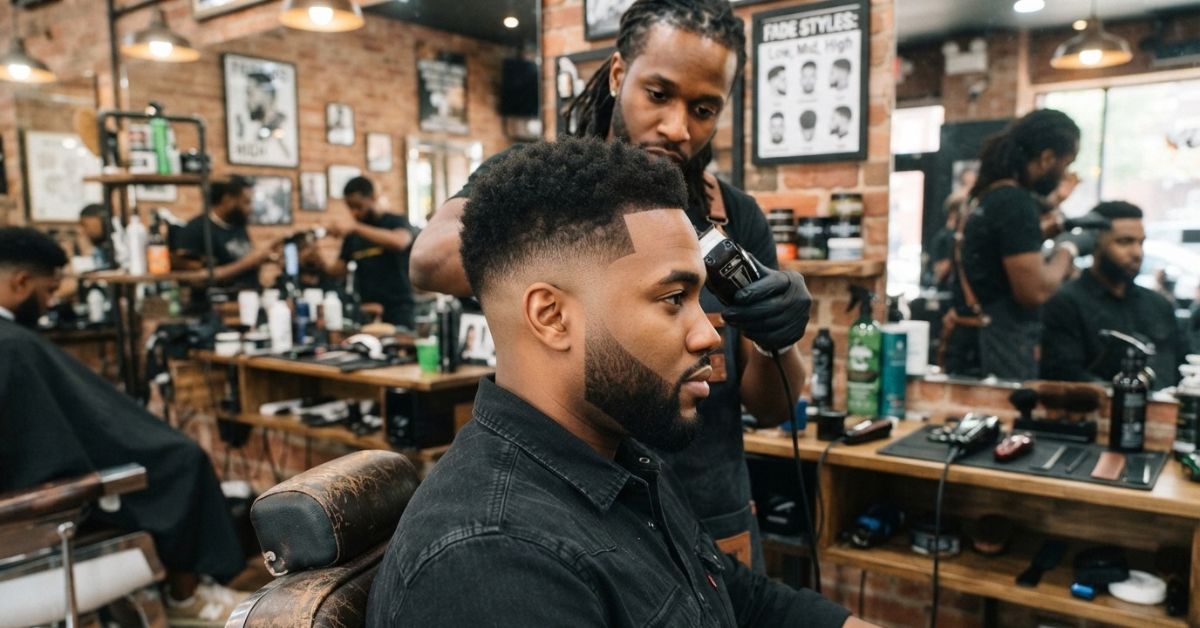
Quick answer: Fades suit Black hair better than any other texture. Coily and kinky strands hold their position instead of falling flat, so a fade line stays crisp. Low, mid, high, burst, drop, temp, and skin fades all work. The right one depends on your curl type (Type 3 or Type 4), your face shape, and how your hair behaves once it’s dry, not fresh out of the shower.
The fade grew out of Black barbershop culture in the 1940s and 1950s, designed to work across the full range of Black hair textures, from loose Type 3 curls to tightly coiled 4C. Nearly every variation since builds on that foundation. Finding a fade that works on Black hair isn’t hard. Finding the one that works on your texture is.
Why Does the Fade Work So Well on Black Hair?
Black hair falls mostly into Type 3 (curly) and Type 4 (coily or kinky). Both hold a fade line more cleanly than straight or wavy hair. Coily and kinky strands don’t lie flat after cutting, so each one stays where the clippers leave it. That’s why a skin fade on 4C hair looks sharper than the same cut on fine, straight hair.
Type 3 (3A, 3B, 3C): Loose to defined curls. Fades blend naturally through the transition zone, every height works, and the curl pattern on top stays visible even after a high skin fade.
Type 4 (4A, 4B, 4C): Tightly coiled to kinky, and the densest hair type. Fades cut precisely and hold their line, but shrinkage is a major factor. Dry 4C hair can be less than half its wet length. A fade that sits at the temple when your hair is wet can ride much higher once it contracts.
The rule is simple: tell your barber the height you want based on how your hair looks dry, not wet.
The 32 Best Fade Haircuts for Black Men
Every style below works on Type 3 and Type 4 hair. Your choice comes down to texture, face shape, and how much upkeep you’ll sign up for.
Low Fades
1. Low Fade
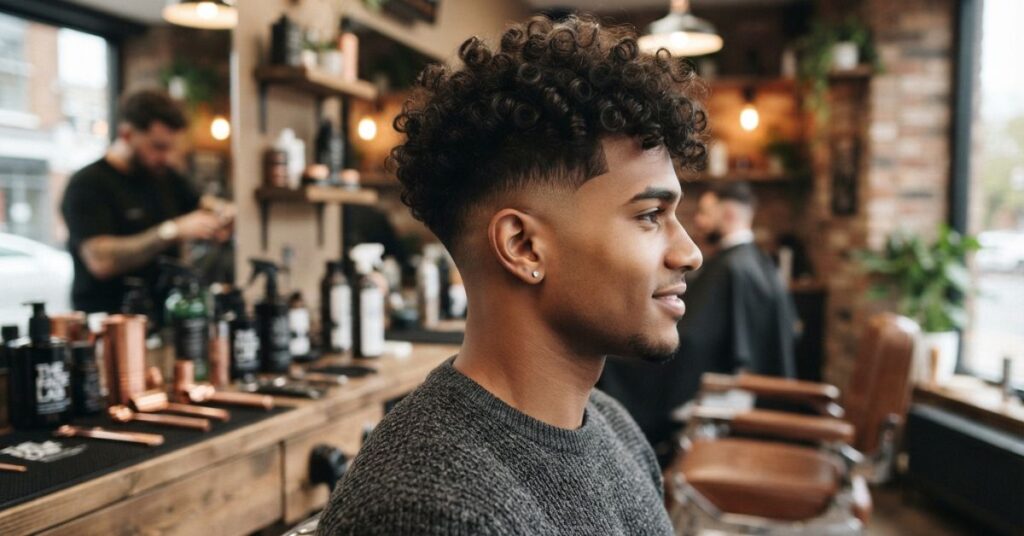
The most conservative option. The fade begins just above the ear and stays close to your natural hairline, so you keep most of your side length. It suits office settings, first-time fade wearers, and men with long or oblong faces.
Say: “Low fade, just above the ear. Keep my hairline natural.”
Upkeep: Every 3–4 weeks.
2. Low Fade with Waves
360 waves need a fade that stays out of their way. Starting just above the ear leaves enough side hair to flow into the wave pattern instead of cutting against it. Brush regularly with a medium or hard brush and wear a durag between sessions.
Say: “Low fade above the ear. I’m wearing waves on top, so keep the sides clean.”
Upkeep: Fade every 3 weeks, lineup every 2.
3. Low Taper Fade
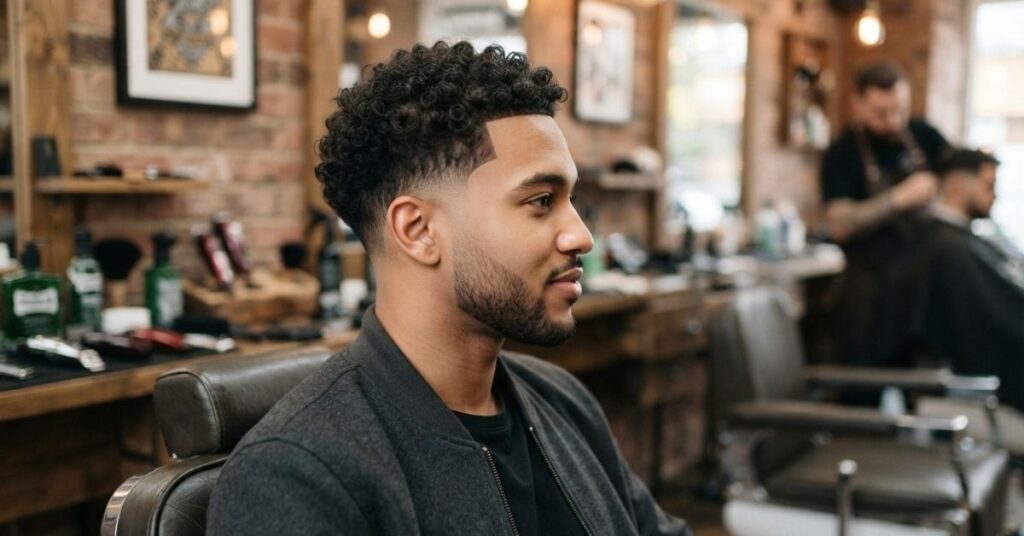
A taper starts above the ear but never reaches bare skin, leaving hair at the neckline. On coily hair this is the most forgiving cut between visits, because new growth blends in instead of exposing a skin line. It’s ideal for professional settings and anyone who wants 4–5 weeks between appointments.
Say: “Low taper. Start above the ear, keep some hair at the base, don’t go to skin.”
Upkeep: Every 4–5 weeks.
4. Low Temp Fade
The fade concentrates around the temples and front hairline, with fuller hair toward the back. It’s a favorite on Type 4 hair with shorter tops, because the sharp temple edge frames the face without fading the whole side. A lineup almost always comes with it.
Say: “Low temp fade, tight at the temples, fuller at the back, clean lineup in front.”
Upkeep: Every 2–3 weeks. The temple edge softens first.
Mid Fades
5. Mid Fade
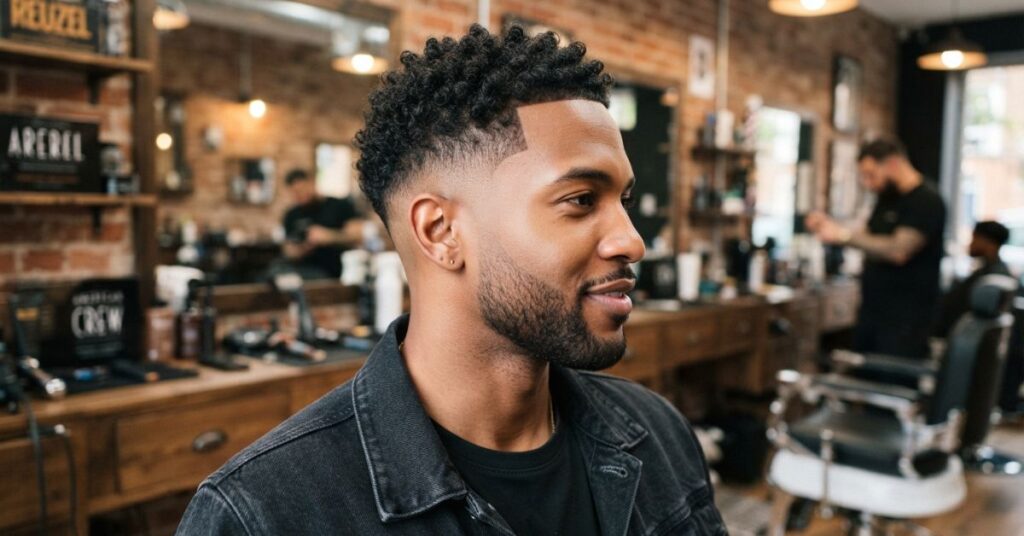
The most requested fade in most shops, and for good reason. Starting at temple level gives enough contrast to show off your texture on top without stripping the sides. It works with everything from short afros to longer twists and flatters every face shape.
Say: “Mid fade starting at the temple, blended clean. Set the height for dry hair.”
Upkeep: Every 2–3 weeks.
6. Mid Fade with Curls
With Type 3B or 3C curls on top, a mid fade gives the curls room without the sides competing. Ask for scissor-over-comb work at the transition so the curls melt into the sides rather than stopping at a hard line.
Say: “Mid fade at the temple, scissor-over-comb at the transition. I want the curls to blend naturally.”
Upkeep: Every 2–3 weeks.
7. Mid Fade with Beard

The fade starts at the temple and runs down into the beard at the sideburn. Coarse beard hair doesn’t blend like fine hair, so the barber has to fade the sideburn gradually into the beard. Without instructions, many barbers leave a visible disconnect.
Say: “Mid fade at the temple. Blend the sideburn into the beard with no hard stop. My beard is coarse, so take your time there.”
Upkeep: Fade every 2–3 weeks, beard trim alongside.
8. Medium Fade Textured Crop
Short, choppy layers with the fringe pushed forward over a mid fade. It works on Type 3 and softer 4A hair, where the crop keeps its definition instead of shrinking flat, and on relaxed or straight Black hair, where point-cutting adds movement a blunt cut can’t. It’s a sculpted-forward look, quite different from the outward-growing afro.
Say: “Mid fade on the sides, textured crop on top. Point-cut the fringe, don’t cut it blunt.”
Upkeep: Fade every 2–3 weeks, crop trim every 5–6.
High Fades
9. High Fade
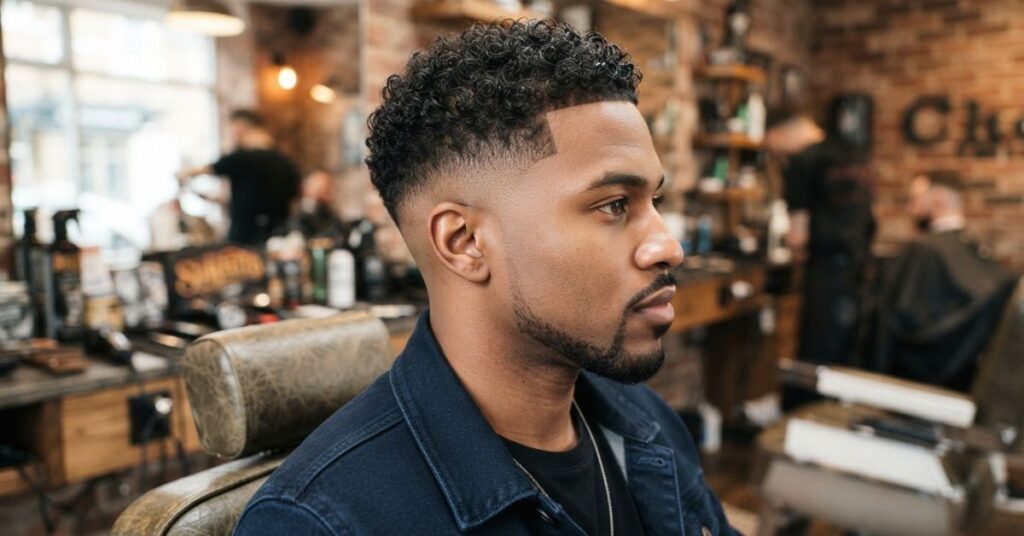
The fade starts above the temples for maximum contrast. On dense 4C hair it looks sharper than on any other texture, but it needs that density on top, or the cut looks sparse instead of bold. Skip it if your hair is fine or thinning, since a high skin fade would expose too much scalp. It suits oval, round, and square faces.
Say: “High fade above the temples, tight on the sides.”
Upkeep: Every 1–2 weeks.
10. High Skin Fade with Waves
Waves on top, a high skin fade on the sides. A popular Black barbershop variation has the fade line follow the hairline’s direction diagonally instead of running strictly horizontal. Find a barber who knows waves, because the wave movement has to stay continuous down to the skin line.
Say: “High skin fade, bald at the base. Follow my hairline direction. I’m wearing 360 waves on top.”
Upkeep: Every 1–2 weeks.
11. High Top Fade
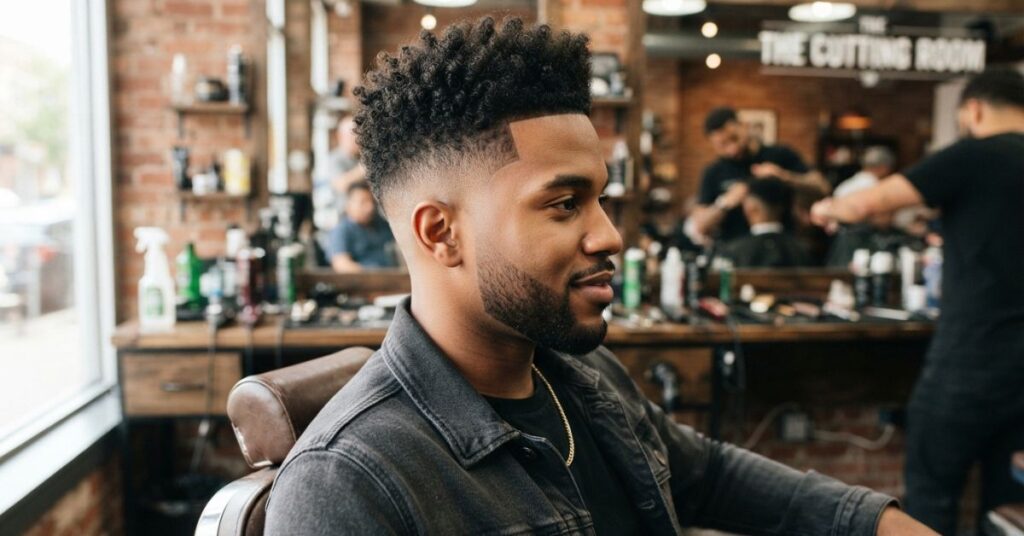
The sides fade to skin while the top grows long and is shaped into a tall, flat, boxy structure. It depends on Type 4 coils, whose tight pattern holds the shape. It rose to popularity in the 1980s and ’90s and is still current. The flat edge needs a razor-straight finish, so choose your barber carefully. It looks best on oval and round faces.
Say: “High top fade. Skin on the sides, leave the top long enough to shape into a flat top, squared off clean.”
Upkeep: Every 1–2 weeks. The flat edge blurs fast.
12. High Fade Afro
A natural afro on top over a high fade creates the biggest possible contrast between tight sides and full volume. It works across all Type 4 patterns. On 4C hair, set the fade height by your dry hair, because the afro sits lower after contraction, which makes the fade line appear to climb.
Say: “High fade on the sides, natural afro on top. Set the height based on how my hair looks dry.”
Upkeep: Every 2 weeks.
13. High Fade with Design
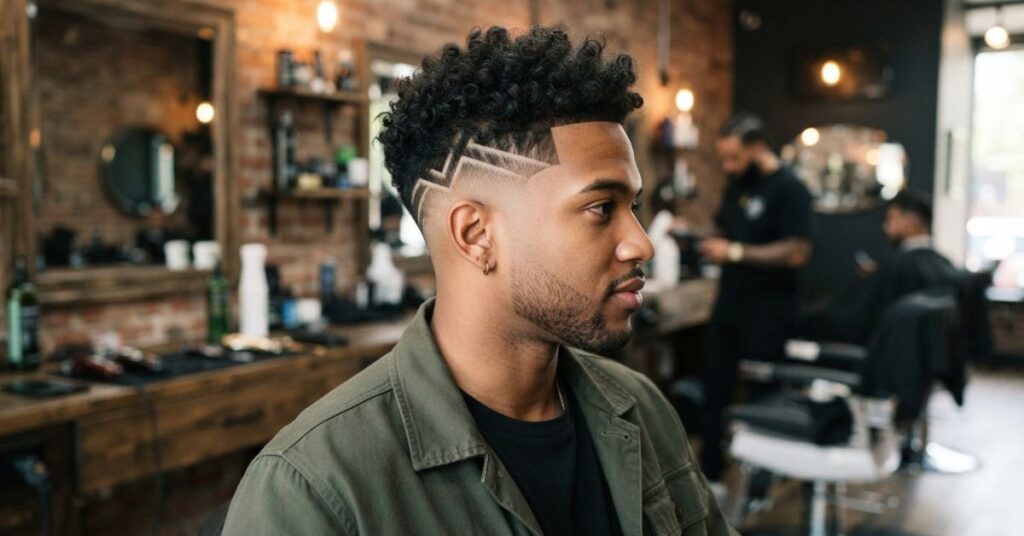
The big faded area on a high fade makes a perfect canvas for geometric lines, curves, or shaved shapes. A hard part is the most conservative option. Elaborate patterns call for a barber who specializes in designs.
Say: “High fade on the sides. Add [your design] in the faded area and sharpen the lineup.”
Upkeep: Every 1–2 weeks. Designs fade faster than the cut.
Skin and Burst Fades
14. Skin Fade
The hair at the base goes down to bare skin (a #0 guard) and is finished with a straight razor. Against natural coily texture, that contrast is as sharp as it gets. Michael B. Jordan has worn this look consistently. Quality varies a lot between barbers, since clipper work alone isn’t enough. Trimmer detailing and razor work around the edges separate a clean skin fade from a truly sharp one. It suits dense, thick hair and every face shape.
Say: “Skin fade, bald at the base, straight razor finish. Make it [low/mid/high].”
Upkeep: Every 1–2 weeks. Growth shows in days.
15. Burst Fade

The fade curves around the ear in a semicircle, leaving the back longer than a standard fade. The arc follows the head’s natural growth pattern, and on 4C hair it handles shrinkage better than a straight line because the curve absorbs the contraction. It’s common with mohawks, natural afros, and frohawks, and flatters all face shapes, especially round and square ones.
Say: “Burst fade, curved arc around the ear, more length at the back.”
Upkeep: Every 2–3 weeks.
16. Burst Fade Mohawk
A strip of longer hair runs down the center with a burst fade arcing around each ear. On Type 4 hair, the strip’s density and coil keep it defined without product, and the burst preserves back length that a standard high fade would remove.
Say: “Burst fade on the sides, leave a strip down the center, arc around the ear, blend the edges.”
Upkeep: Every 2 weeks.
Drop and Temp Fades
17. Drop Fade
The fade line dips behind the ear instead of staying level, creating a rounded, sculpted silhouette at the back of the head. It looks great with waves, thick curls, twists, or braids. A drop mid fade keeps mid-level height on the sides before dropping.
Say: “Drop fade. Let the line curve and drop lower at the back, and keep it sharp where it drops.”
Upkeep: Every 2–3 weeks.
18. Drop Fade with Waves
360 waves on top with the drop curving behind the ear. The drop adds back-of-head shape to a waves-and-fade combination, and the wave pattern flows into the curved line instead of running into a straight edge.
Say: “Drop fade. I’m wearing waves, so keep the pattern continuous into the drop.”
Upkeep: Every 2–3 weeks.
19. Temp Fade (Temple Fade)
Sharp around the temples and front hairline, longer at the back. It’s the standard base for shorter styles like buzz cuts, sponge curls, and low afros, where the front carries the visual interest, and it’s often paired with a lineup.
Say: “Temp fade, tight around the temples and frontal hairline, back fuller, clean lineup.”
Upkeep: Every 2–3 weeks.
20. Fade with Lineup (Edge-Up)
A lineup, also called an edge-up or shape-up, is a razor-sharp outline around the forehead, temples, and sometimes behind the ears. It isn’t its own fade, but an add-on to any of them. A good barber reads your natural M-shape or widow’s peak and sharpens it. Forcing a straight line onto a curved or receding hairline looks artificial.
Say: “Add a lineup after the fade. Follow my natural hairline, don’t force it straight.”
Upkeep: Every 2 weeks. It’s the first thing to blur.
Fades Built Around Your Top Style
21. Fade with 360 Waves
Waves form through repeated compression and brushing, so the fade should keep out of their way. Choose a low or mid fade, start with a hard brush while training, and move to a medium brush for maintenance. This works best on Type 3C–4A hair.
Say: “Mid or low fade. I’m training waves on top, so keep the sides clean and the transition smooth.”
Upkeep: Fade every 3 weeks, lineup every 2.
22. Fade with Afro
The most natural pairing for Type 4 hair. A low fade gives a fuller silhouette, while a high fade gives maximum contrast. Keep the afro moisturized with a leave-in conditioner or curl cream, and seal it with a light oil. Healthline’s hair care guidance notes that sealing moisture with oil after conditioning benefits coily hair.
Say: “Fade on the sides, natural on top. I want the afro shape. Set the height for dry hair.”
Upkeep: Every 2–3 weeks.
23. Fade with Dreadlocks
Locs on top against tight faded sides make a bold, deliberate contrast, and the longer the locs, the more dramatic it looks. Any fade height works, depending on how daring you want to be. Travis Scott has worn this look with a burst fade.
Say: “Fade on the sides, keep the locs, arc around the ear if it’s a burst, clean edges at the lineup.”
Upkeep: Fade every 2–3 weeks, locs maintenance separate.
24. Fade with Braids
Cornrows or box braids on top with a mid fade, which gives the braids room to flow. A drop fade pairs especially well with longer braids because the curved back line follows their direction.
Say: “Mid fade on the sides. I’m getting braids on top, so keep the sides clean and the lineup sharp.”
Upkeep: Fade every 3 weeks. Braids hide grow-out.
25. Fade with Twists
Two-strand twists give natural definition on Type 4A and 4B hair without heavy product. A mid or high fade makes the contrast between textured top and tight sides stand out.
Say: “Mid fade on the sides. I’m wearing twists on top, so keep the sides tight and the lineup clean.”
Upkeep: Every 2–3 weeks.
26. Fade with Sponge Curls
A hair sponge creates defined coils on short natural hair, working best on Type 4A and 4B. Pair it with a temp or low fade to keep the front hairline sharp while the curls provide the interest.
Say: “Temp or low fade. I’m using a sponge on top, so keep the front hairline sharp.”
Upkeep: Every 2–3 weeks.
27. Fade with Hard Part
A razor-cut line shaved into one side. On Black hair, the coil pattern gives it an especially clean edge. A mid fade on both sides with a hard part on the left reads professional and sharp at once.
Say: “Mid fade on both sides, razor hard part on the left, about an inch back from the hairline.”
Upkeep: Every 2 weeks. The part blurs before the fade does.
28. Frohawk Fade
Natural coily texture runs in a strip from front to back, with the sides faded. Unlike a mohawk, the strip stays natural instead of being shaped upward. A high burst fade gives maximum contrast while keeping the back length the strip needs. It suits oval and oblong faces and Type 4 hair.
Say: “High burst fade on the sides. Leave a natural strip of coily hair down the center and don’t touch the top.”
Upkeep: Every 2 weeks.
29. South of France Fade
A diagonal fade that starts at the temple and slopes toward the ear instead of running straight across. Paired with waves or defined curls, it ties the hairline into the whole cut, a more personalized alternative to the standard horizontal line.
Say: “South of France fade. I want a diagonal line following my hairline, not straight across.”
Upkeep: Every 2–3 weeks.
30. Buzz Cut Fade
A short, even buzz on top with a fade on the sides. On coily hair, a mid or high skin fade makes the top texture look intentional, and daily styling is minimal. A low taper version keeps the sides slightly fuller.
Say: “Mid fade on the sides, number two or three on top, skin at the base.”
Upkeep: Every 2 weeks.
31. Faux Hawk Fade
Hair is styled upward along the center without fully shaving the sides. Coily hair gives natural lift, especially Type 3C and 4A, where defined curls in the center create height. A burst or high fade adds contrast without committing to a full mohawk.
Say: “Burst or high fade on the sides. Leave a strip down the center long enough to push up.”
Upkeep: Every 2 weeks.
32. High Fade with Kinky Top
A high skin fade on the sides with short 4B or 4C hair left completely natural on top, with no shaping and no product. The contrast between bare sides and dense kinky texture is immediate. A clean lineup frames the front.
Say: “High skin fade on the sides, leave the top natural with no shaping, sharp lineup at the front.”
Upkeep: Every 1–2 weeks.
What Happens to a Fade on Black Hair When It Dries?
Most fade guides skip this. Coily and 4C hair can shrink by half its length or more as it dries, so a fade cut at one height can look noticeably higher by the time you walk out.
- Low fade on 4C: Even the lowest starting point can climb past the ear once dry. A low fade set wet can read as a mid fade.
- Mid fade on 4C: It almost always reads higher when dry, and on very tight coils it may look like a high fade.
- High fade on 4C: It already starts above the temples, and shrinkage can push it further than you’d like.
The fix: Ask your barber to set the height on dry hair. If you’ve just washed, let it dry before you sit down. If you can’t wait, say it explicitly: “Mid fade at temple level when my hair is dry, not wet.”
Which Fade Suits Your Hair Type?
| Hair type | Pattern | Best fades | Key note |
|---|---|---|---|
| Straight/relaxed | Flat or loose wave | Any height | Sharpest lines, since hair lies flat |
| 3A | Loose curls | Low or mid | Curls blend naturally |
| 3B | Defined curls | Mid or high | Ask for scissor-over-comb |
| 3C | Tight curls | Mid or burst | Moderate shrinkage |
| 4A | S-pattern coils | Mid or burst | Significant shrinkage; set height dry |
| 4B | Z-pattern coils | Low or mid, shadow fade | Dense; skin fades look very sharp |
| 4C | Tightest coils | Low or mid, shadow or skin | Highest shrinkage; always set dry |
A note on shadow fades: On very tightly coiled 4B and 4C hair, a shadow fade, which stops at stubble instead of bare skin, can look more natural than a hard skin line. The soft gradient from dark stubble suits dense texture well.
How Do You Choose the Right Fade?
By face shape
| Face shape | Best height | Why |
|---|---|---|
| Oval | Any | Balanced proportions |
| Round | Mid or high | Adds visual height |
| Square | Mid or high | Adds structure |
| Oblong/long | Low only | Doesn’t add height |
| Diamond | Mid | Keeps side width |
| Heart | Low or mid | Avoids sharpening the temples |
By lifestyle
- Office or formal: A low taper or low skin fade. A mid fade with a lineup is about as far as most formal workplaces go.
- Creative or casual: Any height.
- Athletic: A mid or high skin fade, which stays clean as it grows out.
- Low maintenance: A low taper, which holds 4–5 weeks on coily hair.
With a receding hairline: You still have options. A temp fade with a tight lineup that follows your natural M-shape or widow’s peak is the cleanest approach. Avoid high fades that start above the recession, because they draw attention to it instead of framing it.
What Should You Tell Your Barber?
Beyond height and closeness, three details matter most on Black hair:
- Wet vs. dry: “Set the fade height based on how my hair looks dry.”
- Hairline: “Follow my natural hairline. Don’t force it straight.”
- Beard blend: “Blend the fade into my beard at the sideburn. My beard is coarse, so take your time.”
Quick phrases to keep handy:
- Low fade: “Low fade just above the ear, following my natural hairline.”
- Mid fade: “Mid fade at the temple, blended clean, height set for dry hair.”
- High fade: “High fade above the temples, tight on the sides, skin at the base.”
- Burst fade: “Burst fade with a curved arc around the ear and length left at the back.”
- Temp fade: “Temp fade, sharp at the temples, fuller at the back, lineup in front.”
- Lineup: “Add a lineup that follows my natural hairline.”
How Often Should Black Men Get a Fade?
| Style | Frequency | Why |
|---|---|---|
| High skin fade | Every 1–2 weeks | Growth shows within days |
| High top fade | Every 1–2 weeks | Flat top loses its edge fast |
| Fade with design | Every 1–2 weeks | Designs fade faster than the cut |
| Standalone lineup | Every 2 weeks | First element to grow out |
| Mid skin fade | Every 2 weeks | Most barbers’ recommendation |
| Burst fade | Every 2–3 weeks | Arc loses definition |
| Mid taper | Every 2–3 weeks | Moderate grow-out |
| Low skin fade | Every 2–3 weeks | Skin line shows growth |
| Low taper | Every 4–5 weeks | Base hair absorbs growth |
| Low fade with braids or locs | Every 3–4 weeks | Top style hides grow-out |
Between visits: Keep the neckline tidy with a trimmer at home, and avoid heavy products on the faded sides, since buildup makes uneven growth more obvious and the fade look patchy sooner. The American Academy of Dermatology advises keeping coily hair moisturized and limiting heat and friction between styling sessions, which helps the texture on top stay healthy between touch-ups.
The Biggest Mistake Black Men Make with a Fade
Asking for a perfectly straight lineup on a naturally curved hairline. Forcing a straight edge across an M-shaped hairline or a widow’s peak looks unnatural and ages faster than the fade itself. A lineup should sharpen what’s already there, not rebuild it into something it isn’t.
FAQ
What is the best fade haircut for Black men?
The mid fade is the most versatile. It works on every face shape, every Type 3 and Type 4 pattern, and in nearly every setting. If you’re unsure, start there and adjust.
What fade looks good on Black hair?
All of them. Coily and kinky texture holds a fade line more precisely than any other hair type, so the choice comes down to your texture, face shape, and how much maintenance you want.
How often should Black men get a fade?
A low taper every 4–5 weeks, a mid fade every 2–3 weeks, and a high skin fade or fade with a design every 1–2 weeks. Lineups need a touch-up about every 2 weeks regardless of fade height.
Can straight hair get a fade?
Yes. Black men with relaxed or naturally looser hair (Type 3A) can wear fades well, and straight hair produces very crisp lines because it lies flat and cuts precisely.
What is a lineup for Black men?
A razor-sharpened outline around the forehead, temples, and sideburns, added after any fade. On Black hair, it’s the finishing detail that takes a clean fade to a sharp one.
How do you maintain a fade with coily hair?
Tidy the neckline with a trimmer between visits and keep the top moisturized, since dry coily hair loses definition quickly. A leave-in conditioner followed by a light oil seals the moisture in.
Which fade lasts longest on coily hair?
The low taper. The hair at the base absorbs new growth instead of creating a visible skin line, so it holds 4–5 weeks on Type 4 hair.
What is a temp fade?
A temple fade, concentrated tightly around the temples and front hairline while the back stays longer. It’s often paired with a lineup and is common on shorter styles like buzz cuts, sponge curls, and low afros.

Evan Blake is a hair style writer and contributor at Faxhion Styles. He focuses on researching haircuts, styling ideas, hair trends, and practical grooming topics. His goal is to present clear, useful, and reader friendly information that helps audiences explore different styles and make informed choices for their individual hair needs.