

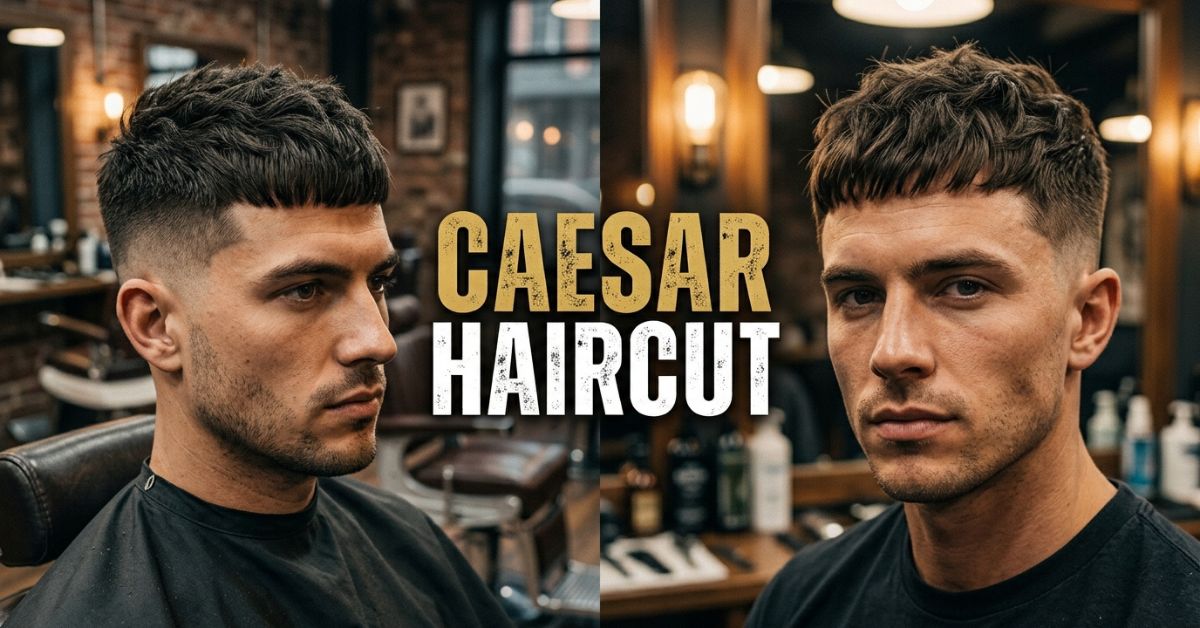
Quick Answer: A Caesar haircut is a short men’s cut with an even top and a straight, blunt fringe brushed forward. Top length runs from about 0.5 to 3 inches depending on the variation. It pairs with a taper, fade, or uniform sides, suits most hair textures, and works especially well for temple recession. Most men book a trim every 2 to 4 weeks.
Few cuts look good both fresh from the chair and two weeks later. The Caesar does. The forward fringe frames the forehead, the short length keeps styling quick, and the shape hides a receding hairline better than most short cuts.
This guide covers 20 Caesar variations, exact words to say to your barber, face shape and hair type matches, styling steps, costs, and product picks. Use the table of contents to jump to what you need.
What Is a Caesar Haircut?
A Caesar haircut is a short cut with an even top layer and a blunt, horizontal fringe that sits across the forehead. The sides can be uniform, tapered, or faded.
The name comes from Julius Caesar. Ancient accounts describe him combing his hair forward, and many people believe he did it to cover thinning. The style returned to mainstream fashion through Russell Crowe in Gladiator and George Clooney on ER.
Three details define it:
- Fringe: blunt, straight across, brushed forward
- Top length: about 0.5 to 3 inches, depending on the version
- Sides: uniform, tapered, faded, or undercut
Clipper Guard Chart
Guard numbers decide your result, so here is a quick reference. Sizes vary slightly by brand.
| Guard | Length | Typical Use |
|---|---|---|
| #1 | 1/8 inch (3 mm) | Tight sides |
| #2 | 1/4 inch (6 mm) | Short sides |
| #3 | 3/8 inch (10 mm) | Classic sides or very short top |
| #4 | 1/2 inch (13 mm) | Shortest workable top |
| #6 | 3/4 inch (19 mm) | Short Caesar top |
| #8 | 1 inch (25 mm) | Standard Caesar top |
20 Best Caesar Haircut Styles for Men
1. Classic Caesar Cut

The original. The top, sides, and back share one length, with a blunt fringe at the hairline. It grows out evenly, so you can wait longer between visits.
- Best for: Oval and square faces, straight or wavy hair
- Tell your barber: “Classic Caesar, #4 guard all over, straight fringe, tapered neckline, no fade.”
- Trim: every 3 to 4 weeks
2. Modern Caesar with Low Fade

This keeps the forward fringe but adds a low fade for cleaner contrast. The top gets light texture. It is the most requested version because it feels sharp without being extreme.
- Best for: Most face shapes and hair types
- Tell your barber: “Modern Caesar, textured top, low fade starting above the ear, blunt fringe.”
- Trim: every 2 to 3 weeks
3. Textured Caesar Cut

Point cutting adds small notches that separate the strands. The result has movement but keeps the short fringe shape. Thick hair benefits most because texturizing removes bulk.
- Best for: Square and round faces, thick or coarse hair
- Tell your barber: “Point cut the top, keep the fringe forward but soft at the edges, mid fade.”
- Trim: every 2 to 3 weeks
4. Short Caesar Cut

Here the top sits at about 0.5 to 1 inch (#4 to #8). The fringe is subtle, and styling is nearly zero. Head shape matters more because the hair sits close to the scalp.
- Best for: Oval, diamond, and heart faces, fine hair
- Tell your barber: “Short Caesar, #4 on top, fringe shaped at the hairline, tight taper on the sides.”
- Trim: every 2 to 3 weeks
5. Long Caesar Cut

This version leaves 2 to 3 inches on top, so the fringe can move and hold a blow dry. Keep the sides short to preserve the shape.
- Best for: Oblong and rectangular faces, medium density hair
- Tell your barber: “Long Caesar, 2 to 3 inches on top, fringe past the hairline, low fade.”
- Trim: every 3 weeks
6. Caesar Mid Fade

The fade starts at the temple, which creates stronger contrast. The fringe looks bolder against the shorter sides, and the cut photographs well.
- Best for: Round, square, and diamond faces, thick hair
- Tell your barber: “Caesar top, mid fade starting at the temple, blend into a #6 on top.”
- Trim: every 2 to 3 weeks
7. Caesar High Fade

The fade begins near the crown line and drops to skin. It gives maximum contrast and makes the fringe look taller. It adds width at the crown, so skip it if you have a round face.
- Best for: Square and diamond faces, dense hair
- Tell your barber: “Caesar with a high fade, start near the crown, keep the fringe sharp.”
- Trim: every 2 weeks
8. Caesar Skin Fade

The sides fade down to bare skin. The blend needs precision, since a rushed job leaves harsh lines. It looks freshest for about 10 days.
- Best for: Oval and heart faces, all hair textures
- Tell your barber: “Skin fade, blend into the top with no hard line, straight fringe.”
- Trim: every 2 weeks
9. Caesar Taper
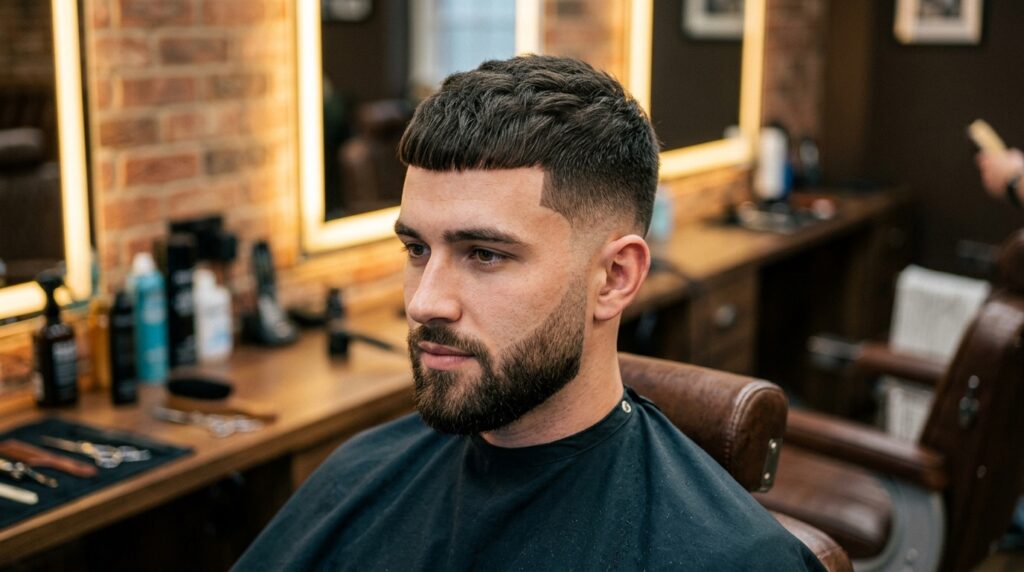
A taper shortens the sides gradually without a visible fade. It looks traditional and grows out cleanly. It also suits conservative offices.
- Best for: Oval, oblong, and heart faces, straight or wavy hair
- Tell your barber: “Caesar with a taper, not a fade, natural neckline, blunt fringe.”
- Trim: every 3 to 4 weeks
10. Caesar Drop Fade

The fade curves down behind the ear instead of running straight across. That arc adds shape from the side and rear.
- Best for: Round, oval, and heart faces
- Tell your barber: “Caesar on top, drop fade, curve the line down behind the ear.”
- Trim: every 2 to 3 weeks
11. Caesar Buzz Cut

The shortest workable Caesar. The top stays at a #4 with forward grain, and the sides go to a #1 or skin. Home maintenance is easy with clippers.
- Best for: Strong jawlines, fine or coiled hair
- Tell your barber: “Buzz Caesar, #4 on top, #1 on the sides, fringe direction forward, light line at the hairline.”
- Trim: every 2 weeks
12. Messy Caesar Cut

This one is finger styled instead of combed. The fringe falls forward with a little unevenness. Sea salt spray works better than pomade here.
- Best for: Oval, diamond, and heart faces, wavy hair
- Tell your barber: “Messy Caesar, slightly uneven fringe, point cut the top, low fade.”
- Trim: every 3 weeks
13. Curly Caesar Cut

The forward fringe works with curl patterns instead of fighting them. Curls shrink when dry, so leave extra length. Ask for a dry cut so the barber sees the real curl length.
- Best for: Oval, round, and heart faces, medium to thick curls
- Tell your barber: “Curly Caesar, cut dry, leave length for shrinkage, tight fade, don’t over thin the top.”
- Trim: every 3 weeks
14. Wavy Caesar Cut

Waves give the fringe a relaxed look, so it never sits ruler straight. Work with your natural pattern and avoid forcing it flat.
- Best for: Oval, square, and oblong faces
- Tell your barber: “Wavy Caesar, keep 1.5 to 2 inches on top, low fade or taper.”
- Trim: every 3 weeks
15. Caesar for Receding Hairline

This is the cut’s original job. The fringe falls over the temples and softens an M shaped recession. Keep the sides tight and skip any sharp line up at the front, because it draws attention to the hairline.
- Best for: Men with temple recession, straight, wavy, or fine hair
- Tell your barber: “Bring the fringe forward over the temples, no line up at the front, soft taper.”
- Trim: every 2 to 3 weeks
16. Caesar Undercut

An undercut creates a hard disconnect between the top and the sides. There is no blend. It looks bold and makes the fringe feel heavier.
- Best for: Square and angular faces, thick hair
- Tell your barber: “Caesar undercut, disconnect the top, #1 on the sides, blunt fringe.”
- Trim: every 2 to 3 weeks
17. Caesar Mullet

A short blunt fringe up front, faded sides, and extra length at the back. The structured front keeps the shape from looking messy.
- Best for: Oval, heart, and diamond faces, wavy or straight hair
- Tell your barber: “Caesar mullet, mid fade, let the back grow past the collar, layer the back.”
- Trim: front every 2 to 3 weeks, back every 4 to 6 weeks
18. Dark Caesar (Black Men)

Designed for coiled and type 4 hair. The top stays short, often shaped with a shaver for a smooth finish. A crisp line up at the forehead and temples frames the face.
- Best for: All face shapes, coiled hair
- Tell your barber: “Short Caesar, shaped smooth on top, skin fade, sharp line up at the forehead and temples.”
- Trim: line up every 2 weeks, full cut every 2 to 3 weeks
19. Caesar with Beard

The fringe and the beard bracket the face. A short Caesar balances a full beard well. A long Caesar paired with a long beard can look unkempt.
- Best for: Square, round, and oblong faces with even beard growth
- Tell your barber: “Mid fade blended into the beard, blunt fringe, clean line at the cheeks.”
- Trim: haircut every 2 to 3 weeks, beard every 1 to 2 weeks
20. Layered Caesar Cut

Soft internal layers lift fine or flat hair without adding length. The fringe stays blunt, while the hair behind it sits at slightly different heights for depth.
- Best for: Oblong, oval, and heart faces, thin or flat hair
- Tell your barber: “Layered Caesar, soft internal layers, blunt fringe, low fade or taper.”
- Trim: every 3 weeks
How Do You Choose the Right Caesar Cut for Your Face Shape?
Match fade height and top length to your face shape. The fringe stays the same, but the surrounding details change the balance.
| Face Shape | Best Caesar | Why It Works | Avoid |
|---|---|---|---|
| Oval | Any variation | Balanced proportions suit everything | Nothing |
| Round | Textured Caesar, mid fade | Height and tight sides lengthen the face | High fade, uniform sides |
| Square | Classic, taper | Blunt fringe matches the jawline | Very short buzz |
| Oblong or Rectangle | Long Caesar, layered Caesar | Forward fringe shortens the face | High fade |
| Heart | Low fade, messy Caesar | Soft fringe balances a wider forehead | Undercut |
| Diamond | Mid fade, textured Caesar | Balances wide cheekbones | Uniform classic |
By Hair Type
- Straight: Classic, taper, or short Caesar. Use matte clay.
- Wavy: Messy, wavy, or textured Caesar. Use sea salt spray.
- Curly: Curly Caesar, cut dry. Use curl cream.
- Coiled (type 4): Dark Caesar with a skin fade. Use argan oil for the scalp.
- Thin or fine: Short or layered Caesar. Use texture powder.
Caesar vs French Crop vs Crew Cut: What’s the Real Difference?
All three are short, but the fringe and direction differ.
| Feature | Caesar | French Crop | Crew Cut |
|---|---|---|---|
| Fringe | Short, blunt, straight | Longer, choppy | None |
| Top length | 0.5 to 3 inches | 1 to 3 inches | 1 to 2 inches |
| Direction | Forward | Forward | Up or back |
| Styling | Minimal | Low to medium | Low |
| Hair loss coverage | Strong | Moderate | Weak |
In short, the Caesar looks disciplined, the French crop looks relaxed, and the crew cut shows more of the forehead.
What Should You Tell Your Barber for a Caesar Cut?
Give three details: top length (guard number or inches), side treatment (fade level or taper), and fringe style (blunt or textured).
Use scripts like these:
- Classic: “#4 on top, even all around, straight fringe, tapered neckline.”
- Modern fade: “Caesar top at #8, blunt fringe, low fade, blend clean.”
- Textured: “Point cut the top, fringe slightly uneven, mid fade.”
- Recession cover: “Fringe forward over the temples, no front line up, soft taper.”
Bring photos of the front, side, and back. Words alone rarely capture fringe angle or fade height.
How Do You Style a Caesar Haircut at Home?
Most Caesar styling takes about two minutes.
- Towel dry your hair until it is damp.
- Apply a pea sized amount of matte clay between your palms.
- Work it through from the back toward the front.
- Brush or finger comb the fringe forward.
- Adjust the edge so the line stays level.
For longer or wavy versions, add sea salt spray to damp roots and blow dry forward on medium heat. For curly or coiled hair, use curl cream or oil on damp hair and air dry. Skip brushing, which flattens curl definition.
How Often Should You Trim a Caesar Cut?
Most men need a trim every 2 to 4 weeks. Skin and high fades sit at 2 weeks, standard fades at 2 to 3 weeks, and tapers or classic cuts at 3 to 4 weeks.
Here is what to expect:
- Weeks 1 to 2: Sharpest lines and strongest contrast.
- Week 3: Sides soften. Still presentable.
- Weeks 4 to 5: Fades blur and the fringe reaches your eyebrows on longer cuts.
- Week 6 and later: The shape is lost. Book a cut.
How Much Does a Caesar Haircut Cost?
In the US, a Caesar haircut usually costs $20 to $50. Chain shops run $15 to $25, and upscale barbershops in big cities can reach $60 to $75 or more.
Skin fades, line ups, and beard trims add to the price. Prices vary widely by country and city, so check local rates. A decent set of clippers costs $30 to $80 once. Only try buzz or short Caesars yourself. Leave fades to a barber.
What Are the Best Products for a Caesar Cut?
Choose matte and lightweight products. Avoid heavy gels and high shine.
- Matte clay: The everyday default with medium hold and no shine.
- Sea salt spray: Adds grip for wavy and messy styles.
- Texture powder: Adds lift at the roots for thin hair.
- Pomade: For a polished look. Use a small amount.
- Curl cream: Defines waves and curls without crunch.
- Argan oil: Keeps the scalp moisturized under very short coiled cuts.
Frequently Asked Questions
Is a Caesar Haircut Professional Enough for the Office?
Yes. Classic and tapered versions suit nearly any workplace. Skin fades read more casual in conservative settings.
Can I Cut a Caesar Haircut at Home?
Buzz and short versions are doable with clippers. Fades and neckline work are best left to a barber.
What’s the Minimum Hair Length Needed for a Caesar?
About 0.5 inch, or a #4 guard. Shorter than that, the fringe cannot lie forward.
Can a Caesar Work on Thick, Coarse Hair?
Yes. Point cutting removes bulk, and a mid or high fade controls volume at the temples.
How Is a Caesar Different from a Textured Crop?
The Caesar fringe is blunt and horizontal. A textured crop is longer, choppier, and more separated.
Should I Get a Caesar If My Hair Is Thinning at the Crown?
Yes, a short even Caesar with texture powder helps conceal early crown thinning. Avoid long versions, which can part and show scalp.
Does the Caesar Suit Curly Hair?
Yes. Curls add natural volume, and the forward fringe works with the curl pattern. Cut it dry for accuracy.
Conclusion
The Caesar remains one of the most practical short cuts in 2026. It is quick to style, adapts to most hair types, and handles a receding hairline better than most alternatives.
Start with your face shape and hair type, then pick a variation from the list. Bring a photo and the script to your barber, and book your next trim at week 3 to keep the lines sharp.

Evan Blake is a hair style writer and contributor at Faxhion Styles. He focuses on researching haircuts, styling ideas, hair trends, and practical grooming topics. His goal is to present clear, useful, and reader friendly information that helps audiences explore different styles and make informed choices for their individual hair needs.